Here is a scene most small business owners know too well. The books say you made a profit last month. Your invoices are going out, customers seem happy, and work is steady. Then Friday rolls around, payroll is due, and the bank account is nearly empty.
Profitable on paper. Broke in real life.
That gap between profit and cash is exactly why you need a cash flow forecast. It is a simple week-by-week plan of the money coming in and going out of your business, so a tight week never catches you by surprise again. In this guide I will walk you through the 13-week method I recommend to almost every owner I work with. No accounting degree needed. If you can add and subtract, you can do this.
A cash flow forecast is a week-by-week (or month-by-month) estimate of the cash your business expects to receive and pay out over a future period, used to predict your bank balance on any given date.
That is the tidy definition. Here is the practical one. It is a calendar for your money. It tells you, in advance, which weeks will feel comfortable and which weeks will hurt.
One thing to be clear about: a forecast is not the same as a profit and loss statement. Your P&L records sales when you invoice them. Your bank account only feels a sale when the customer actually pays, which might be 30 or 45 days later. A forecast follows the money, not the paperwork. That single difference is why businesses with healthy sales still run out of cash.
You could forecast a whole year, and for big planning decisions that has its place. But for day-to-day small business cash flow, 13 weeks works better. Here is why.
Thirteen weeks is one full quarter. That is long enough to cover a full cycle of invoices going out, customers paying late (they will), quarterly tax bills, and seasonal dips. At the same time, it is short enough that your estimates stay honest. Guessing your sales 11 months from now is fiction. Guessing the next 13 weeks is planning.
It also matches how trouble actually arrives. Cash problems rarely show up a year in advance. They show up six weeks out, when a big supplier bill lands in the same week as payroll and a slow-paying client. A 13 week cash flow view puts that collision on paper while you still have time to act.
You can build this in a notebook, but a spreadsheet is far easier to update. Most owners I talk to check their bank balance and call that a forecast. It is not. Work through these six steps once, and after that the weekly update takes about 15 minutes.
Start with what is actually in your business bank account today. Not what should be there. Not what will be there after the pending payments clear. The real number, straight from your banking app.
If you have more than one account that you pay business bills from, add them together. This opening balance is the anchor for everything that follows.
Now list every payment you expect to receive in each of the next 13 weeks. Go through your unpaid invoices and write each one in the week you genuinely expect the money to land, not the week the invoice says it is due.
Be honest here. If a client always pays two weeks late, put the payment two weeks later. Add recurring income too: retainers, subscriptions, regular contract payments. If you make cash sales, estimate a weekly average from the last couple of months, then trim it slightly. Optimism is the number one killer of useful forecasts.
Next, list everything you will pay out. Payroll (including taxes and benefits, not just wages), rent, loan payments, supplier bills, software subscriptions, insurance, utilities, and your own draw or salary.
Go through last quarter's bank statements line by line. You will find payments you forgot existed. Everybody does. Put each cost in the week it actually leaves your account. A bill dated the 28th that clears on the 2nd belongs in the later week.
This is the heart of the whole exercise. For each week, take the opening balance, add the cash in, subtract the cash out. That gives you the closing balance, which becomes next week's opening balance.
A simple cash flow tracker or spreadsheet does this maths for you once the formulas are set up. What matters is the pattern you will start to see: the balance climbing in good weeks, then dipping hard in weeks where big bills cluster together.
Scan the running balance column and mark any week where it drops below a level you are comfortable with, or worse, below zero. Those are your danger weeks.
Finding one is not bad news. Finding one 8 weeks early is the entire point. You now have options: chase an overdue invoice sooner, ask a supplier for an extra two weeks, delay a non-essential purchase, arrange a small credit line while your numbers still look strong, or run a promotion to pull sales forward. Every one of those moves is easier before the crisis than during it.
A forecast you made in January and never touched again is just a souvenir. Pick a fixed slot, Monday morning works well, and spend 15 minutes rolling it forward. Replace last week's estimates with what actually happened, add a new week at the end, and adjust anything you have learned.
Within a month or two, something satisfying happens. Your estimates get sharper, because you are comparing them against reality every single week. The forecast stops being a guess and starts being a tool you trust.
Numbers make this clearer than words. Here is a trimmed-down version for a small design studio with an opening balance of $8,400. (A real forecast shows all 13 weeks. This shows the first five so you can see the pattern.)
| Week | Cash In | Cash Out | Closing Balance |
|---|---|---|---|
| 1 | $3,200 | $2,850 | $8,750 |
| 2 | $1,400 | $6,900 | $3,250 |
| 3 | $4,600 | $2,300 | $5,550 |
| 4 | $2,100 | $7,400 | $250 |
| 5 | $5,800 | $2,950 | $3,100 |
Look at week 4. Payroll and a quarterly tax payment land together, and the balance drops to $250. Nothing is wrong with this business. Sales are fine. But without the forecast, week 4 arrives as a nasty shock. With it, the owner sees the problem a month ahead and can invoice earlier in week 2, or move the tax payment planning up. That is the whole game.
Forgetting tax payments. Sales tax, VAT, and quarterly income tax are the classic ambush. They are real cash out, and they often land in the same week as payroll. Put them in the forecast the moment you know the rough amount, even if the figure is approximate.
Missing irregular bills. Annual insurance, yearly software renewals, licence fees, the accountant's bill at year end. They do not show up monthly, so people leave them out, and then a $1,900 renewal eats a quiet week alive. Scan a full year of bank statements when you set up, not just last month.
Being optimistic about sales and payment speed. Forecasting the month you hope to have, instead of the month you usually have, makes the whole document useless. Use your real averages. If anything, shade them down slightly. A forecast that pleasantly surprises you is far better than one that lies to you.
Building it once and never updating. Already covered above, but it is worth repeating because it is the most common failure of all. Fifteen minutes a week. Put it in your calendar like any other appointment.
Once a week is the standard that works for most small businesses. It takes around 15 minutes once the habit is set. If your cash position is very tight, or you are going through a fast growth phase, twice a week is reasonable. Less than weekly and the forecast goes stale too quickly to trust.
A cash flow statement looks backwards. It reports the cash that actually moved in and out during a past period, and your accountant prepares it from your records. A forecast looks forwards. It is your own estimate of what will move, and when, so you can make decisions before the money runs short. You need both, but only the forecast can warn you about next month.
Yes, and most small businesses do. A spreadsheet is ideal because the running balance formula carries forward automatically, and you can adjust a figure in seconds when a client pays late. Whether you build your own sheet or use a ready-made cash flow spreadsheet template, the method is exactly the same as the six steps above.
Thirteen weeks is the practical standard for operating decisions, because it covers a full quarter of invoices, bills, and tax dates while keeping estimates realistic. Many owners also keep a rough 12-month view for bigger decisions like hiring or buying equipment. The two work well together: the long view for strategy, the 13-week view for staying out of trouble.
You can absolutely build this from a blank spreadsheet. Plenty of owners do. The catch is the setup time: the running balance formulas, the week-by-week layout, and a clear view of where the balance dips. Most people stall there, and the forecast never becomes a habit.
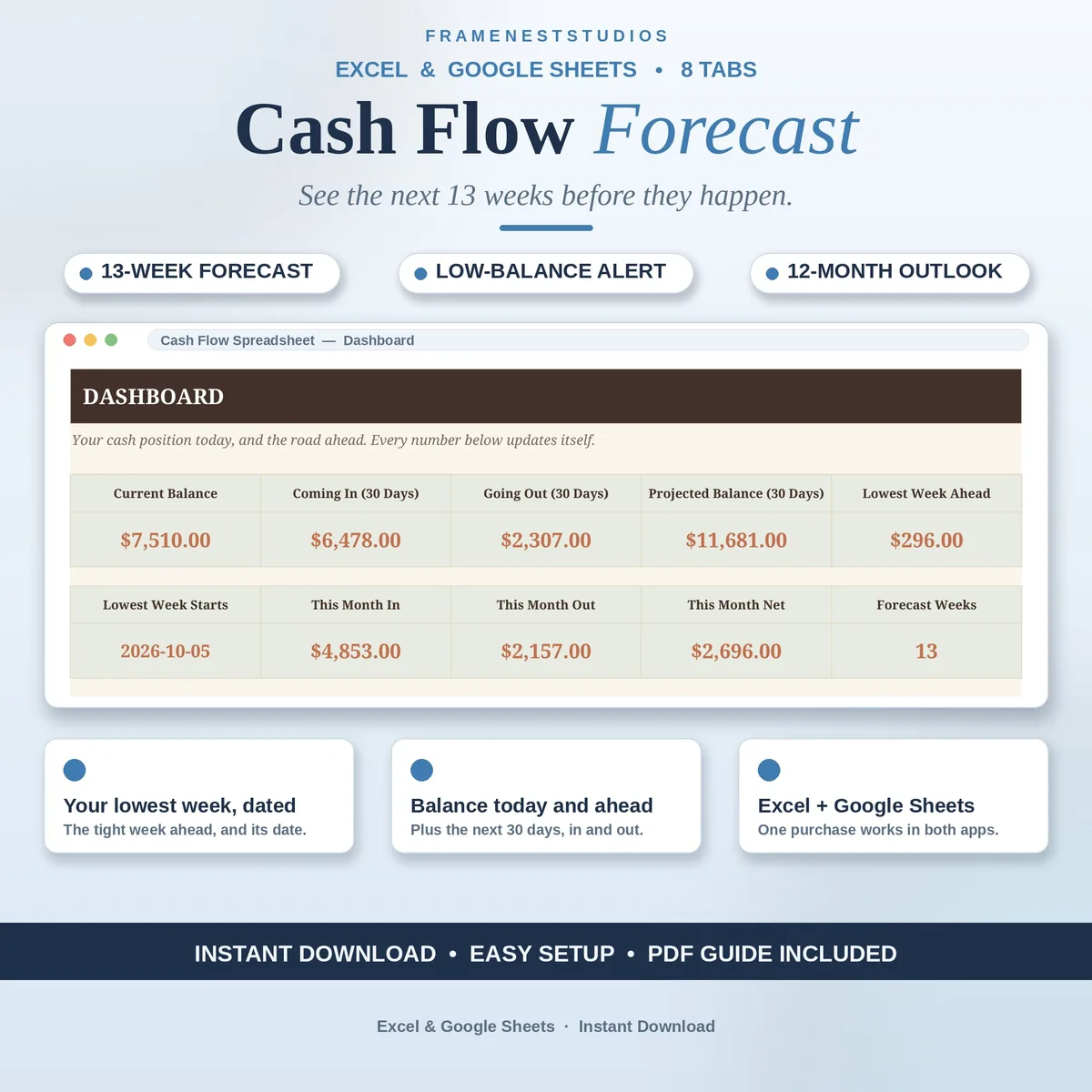
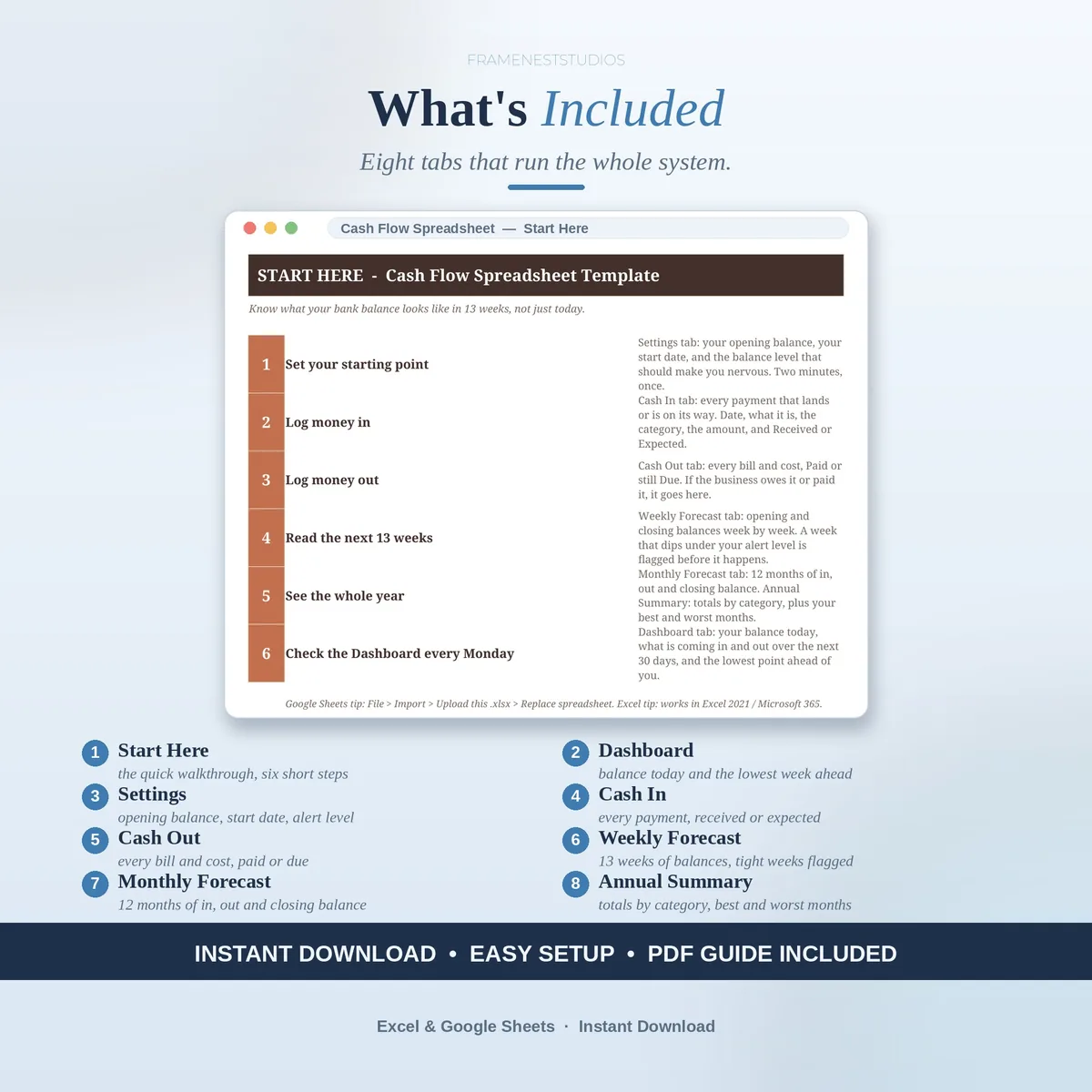
That is why I built the Cash Flow Spreadsheet Template in my Etsy shop, FrameNestStudios. It is set up around this exact method. You get a 13-week forecast sheet, a 12-month planner for the longer view, a dashboard that shows your position at a glance, and a variance report so you can compare what you planned against what actually happened. It works in both Excel and Google Sheets, and it is an instant download, so you can have your first forecast running today instead of spending an evening building formulas.
Short on time? The Small Business Cash Flow Spreadsheet does this for you in Excel and Google Sheets.
However you choose to do it, start this week. Open your bank account, write down the real number, and map the next 13 weeks. The first version will be rough. That is fine. A rough forecast you update beats a perfect one you never start, every single time.
A 13 week cash flow forecast that flags tight weeks before they arrive. See every screen, the full tab list and buyer questions on the product page.
See the Small Business Cash Flow Spreadsheet
Or browse more Bookkeeping & Business Finance templates.