Your monthly budget looks fine on paper. Rent is covered, groceries are covered, the car payment is covered. Then October shows up with a $1,400 car insurance bill, December brings the holidays, and tax season takes another bite in spring. Suddenly the budget that "worked" for eight months is in pieces.
Sound familiar? The problem is not your discipline. The problem is that a monthly budget only sees one month at a time, and real life does not bill you that way. An annual budget fixes this. It looks at the whole year at once, catches the big irregular bills before they ambush you, and spreads their cost across all 12 months so no single month takes the hit.
An annual budget is a plan for your money across a full year. You list everything you expect to earn in 12 months, everything you expect to spend, and you give the irregular bills (the ones that show up once or twice a year) a monthly amount to set aside, so the money is sitting there when the bill lands.
Here is the difference that matters. A monthly budget asks, "Can I afford this month?" An annual budget asks, "Can I afford this year, including the expensive months?" Most households do not have an income problem. They have a timing problem. The money exists across the year, it just is not in the account during the week the big bill arrives. Planning annually solves the timing, and the timing is usually what breaks people.
Start with what actually lands in your bank account, not your salary before tax. Take-home pay is the only number that matters here.
If you are paid every two weeks, multiply one paycheck by 26. Paid monthly, multiply by 12. Add the regular extras too: a side job that reliably brings in $200 a month, child benefit payments, a tax refund you get most years (be conservative with that one). If your income changes month to month because you freelance or work on commission, use your lowest recent year as the base and treat anything above it as a bonus. Budgeting on your best year is how people end up short in the slow months.
Write down the bills that show up every single month: rent or mortgage, utilities, phone, car payment, minimum debt payments, groceries (use a realistic average, not your best month), transport, childcare. Multiply the monthly total by 12 so you can see it next to your yearly income.
This step surprises people. A $65 subscription habit is $780 a year. Groceries at $720 a month are $8,640 a year. Seeing the yearly figure changes how a cost feels, and that is the point. You are not trying to guilt yourself. You are just finally looking at the real size of things.
This is the step that makes or breaks the whole plan, and it is the one almost nobody does. Sit down and list every cost that hits once, twice, or a few times a year. The usual suspects:
Be honest here. That $90 annual subscription you forgot about last year will forget about your feelings again this year. Give every item a yearly figure, even a rough one. A rough number in the plan beats a perfect surprise in real life.
Now the simple trick that makes the whole system work. Take each irregular yearly cost and divide it by 12. That small monthly amount gets moved into a separate savings account (or tracked in your yearly budget spreadsheet) the moment you get paid. When the bill arrives, you pay it from the set-asides and your normal month carries on as if nothing happened.
Here is what this looks like for a household with a $58,000 yearly take-home pay:
| Irregular cost | Yearly amount | Monthly set-aside |
|---|---|---|
| Car insurance premium | $1,440 | $120 |
| Vehicle registration | $240 | $20 |
| Holidays and gifts | $1,200 | $100 |
| Annual subscriptions | $360 | $30 |
| Home repairs fund | $1,800 | $150 |
| Total | $5,040 | $420 |
Look at that table for a second. A $1,440 insurance bill feels like a crisis. $120 a month feels like nothing. Same money, completely different stress level. This household sets aside $420 a month and, in exchange, five of the year's nastiest bills simply stop being emergencies.
With your income, your fixed costs, and your set-asides listed, lay the year out month by month. Most months will look alike. A few will not, and those are the ones you are hunting for.
September might carry school costs on top of everything else. December carries gifts and travel. If your income dips in certain months (teachers paid over 10 months, seasonal workers, freelancers with a quiet January), mark those too. When a tight month shows up on paper six months early, you have options: build a slightly bigger buffer in the fat months, move a flexible cost, or pick up extra work that month on purpose instead of in a panic.
This is also where an annual budget planner earns its keep. Holding 12 months of numbers in your head, or on sticky notes, does not work. You need one place where the whole year is visible at a glance.
A yearly budget is not a January ritual you frame and forget. Put four dates in your calendar, one per quarter, and spend 20 minutes comparing the plan to what actually happened.
Prices go up. A subscription renews at a higher rate. The car needs tires sooner than expected. A quarterly review catches the drift while it is still small and adjustable. Skip the reviews and you will be back to surprise bills by autumn, wondering why the plan stopped working. The plan did not stop. The looking stopped.
Budgeting only the average month. If your plan assumes every month costs the same, your plan is fiction. The whole point of a yearly budget template is that months are not equal. Build for the real months, including the ugly ones.
No buffer line. Something will cost more than you guessed. It always does. Add a small "miscellaneous and buffer" line, even $50 a month, and let it absorb the surprises instead of your grocery money.
Setting it once in January and never looking again. A budget you never review is just a wish with numbers attached. Life changes, prices change, and the plan has to change with them. Quarterly reviews, 20 minutes, that is all it takes.
Making it too complicated. If your system needs 40 categories and a degree to maintain, you will abandon it by March. Ten to fifteen clear categories that you actually update beat a perfect system you avoid opening.
Use your lowest earning month from the past year as your base income and build the plan around that. In better months, send the extra straight into your set-asides and buffer first. That way the plan survives your worst month, and good months just make it stronger.
Everything that repeats, plus everything that surprises you on a schedule. Fixed monthly bills, food, transport and debt payments, then the yearly layer: insurance, registration, holidays, subscriptions, school costs, repairs and tax. If it happened last year, it belongs in this year's plan.
You do not have to pick one. The yearly plan is the map, the monthly budget is the steering. The yearly view catches the big bills and the tight months early, and the monthly view keeps daily spending on track. Most people who switch to planning yearly still check in monthly. They just stop getting ambushed.
Add up all your irregular yearly costs and divide by 12. For many households that lands somewhere between $250 and $500 a month. It sounds like a lot until you compare it with the alternative, which is finding $1,400 in one bad week.
You can build all of this in a blank spreadsheet, and plenty of people do. It takes an evening of setting up formulas, and it works fine until you change one number and three other cells quietly stop agreeing with each other.
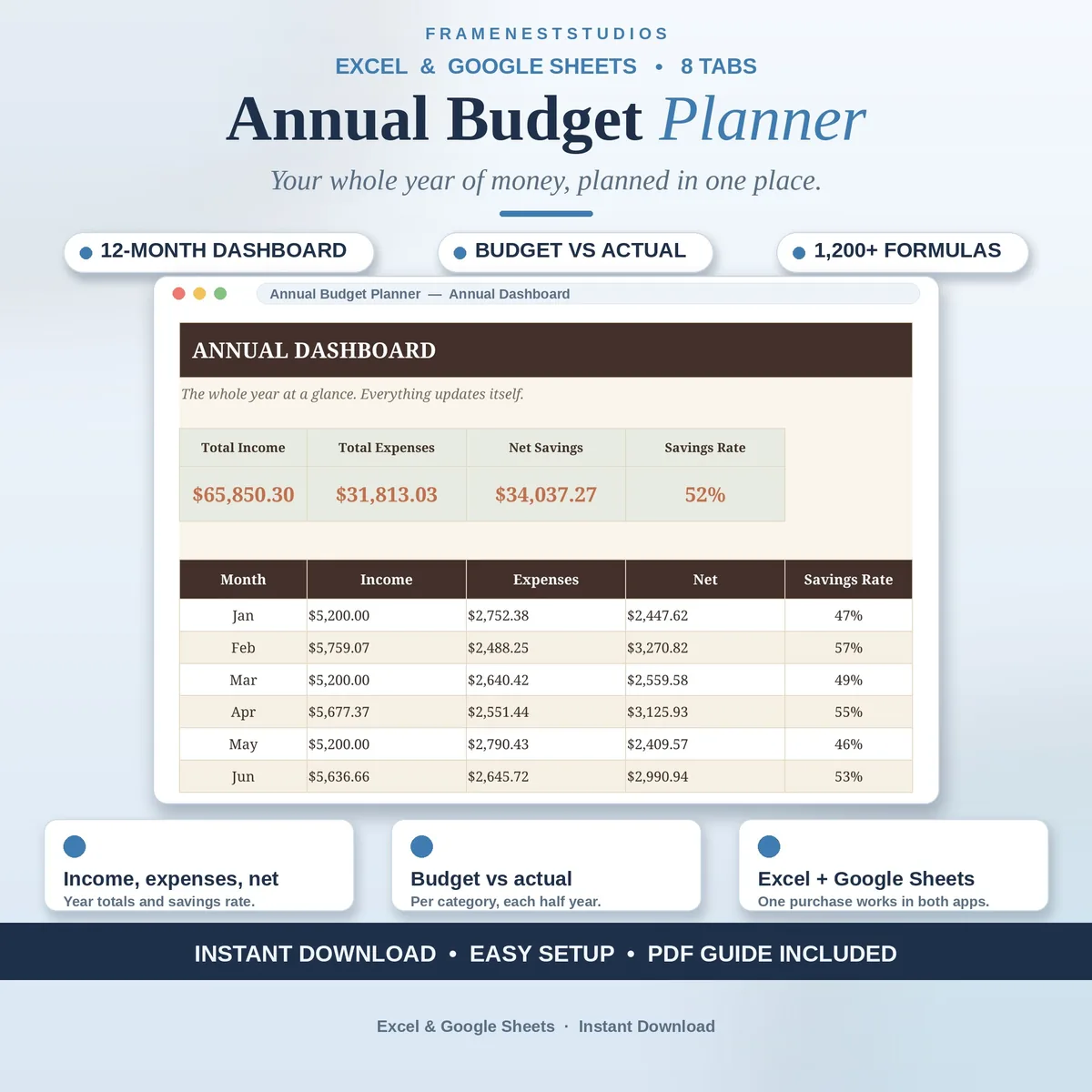
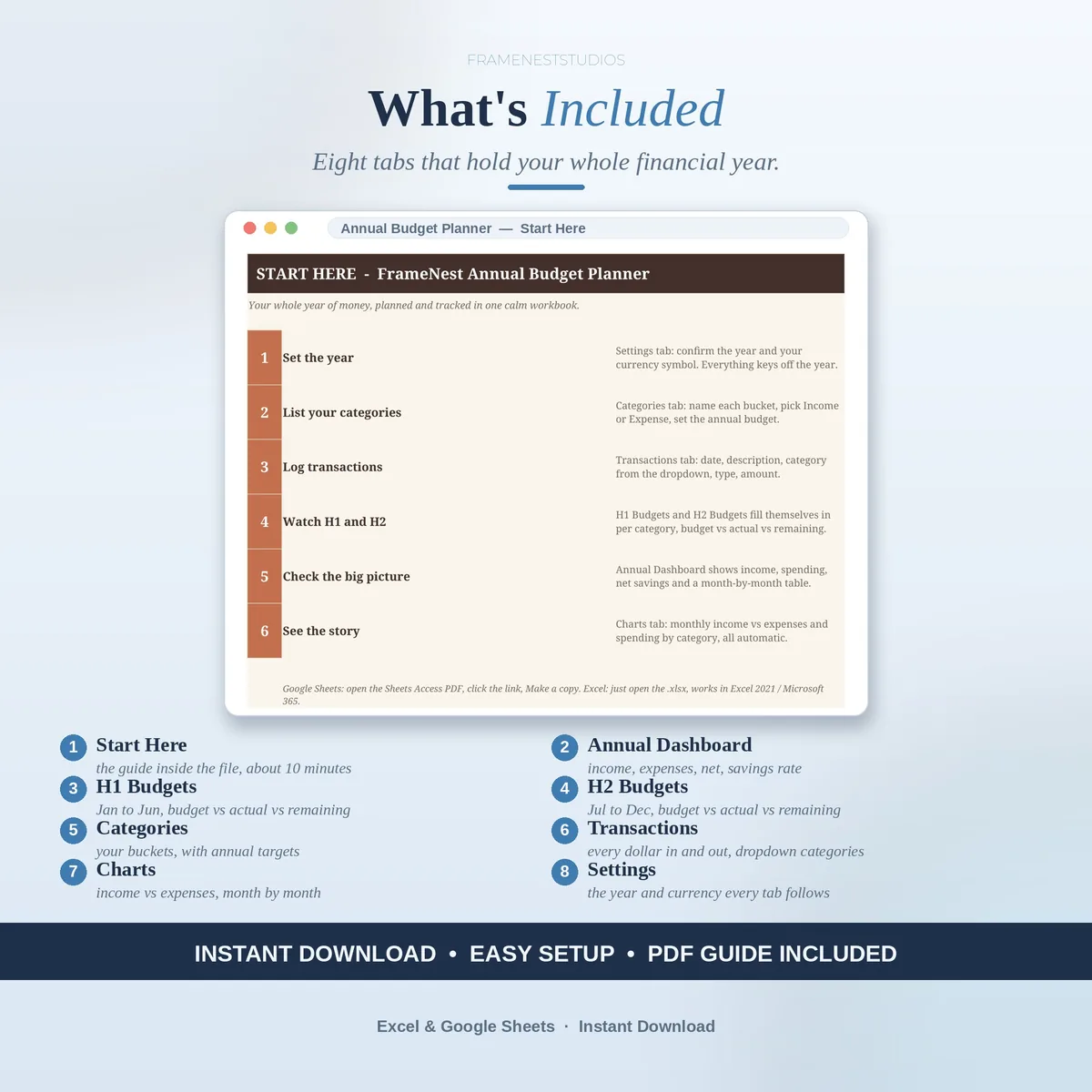
That is exactly why we made our annual budget planner spreadsheets at FrameNestStudios. The year is laid out month by month, the set-aside calculations are built in, and the irregular bills get their own clear section so nothing hides. They work in both Excel and Google Sheets, and they are an instant download on Etsy, so you can have your year planned tonight instead of next weekend.
Short on time? The Annual Budget Planner does this for you in Excel and Google Sheets.
Set it up once, review it four times a year, and let the big bills become boring. Boring is good. Boring means the money was already there.
Hold your whole financial year in one sheet, with yearly targets and automatic monthly updates. See every screen, the full tab list and buyer questions on the product page.
Or browse more Budgeting & Paycheck templates.