Picture this. You go freelance in January, the work goes well, and you earn decent money all year. Then April arrives. Your tax bill is bigger than you expected, and sitting right under it is a penalty. Not because you cheated. Because nobody told you the tax was supposed to be paid during the year, in four chunks, as you earned.
That penalty catches thousands of new freelancers every year. The fix is not complicated, and it starts with understanding one thing: how quarterly tax payments work.
One quick note before we start. This article is general educational information, not tax advice. Tax rules change and everyone's situation is different, so use this to understand the basics, then confirm your own numbers with a tax professional.
If you work for an employer, tax comes out of every paycheck before you see the money. The IRS gets paid all year long without you lifting a finger.
When you work for yourself, nobody does that for you. So the IRS asks you to do it yourself, in four estimated payments spread across the year. These are called quarterly estimated taxes, and each payment is your best estimate of the tax you owe on the income you earned during that part of the year.
Think of it as paying your tax bill in installments instead of one painful lump sum. You are not paying extra tax. You are paying the same tax, just earlier, in pieces.
The short version: if you earn income that has no tax taken out of it, quarterly tax payments are probably part of your life now. That usually includes:
A common rule of thumb you will hear is this: if you expect to owe $1,000 or more in tax for the year beyond anything withheld from a paycheck, the IRS generally expects estimated payments from you. Plenty of people with a regular job still need to pay, because their side income pushes them over the line.
Not sure if that is you? If money lands in your account and no tax was taken off the top, assume yes until a professional tells you otherwise.
The word "quarterly" is a bit of a fib. The four periods are not equal three-month blocks, and the gaps between deadlines are uneven. Here are the standard US due dates for estimated tax payments:
| Payment | Covers income earned | Due date |
|---|---|---|
| 1st payment | January 1 to March 31 | April 15 |
| 2nd payment | April 1 to May 31 | June 15 |
| 3rd payment | June 1 to August 31 | September 15 |
| 4th payment | September 1 to December 31 | January 15 (next year) |
If a due date falls on a weekend or a federal holiday, it shifts to the next business day. Put all four dates in your calendar the day you finish reading this. The June date surprises people every single year, because it lands only two months after the April one.
Estimating sounds like accountant work. It is really just four small steps and some honest numbers.
Look at what you have earned so far this year and what work you have booked or realistically expect. Add it up into one yearly figure. You will not nail it exactly. A sensible, honest estimate beats a wild guess, and you can adjust later in the year.
Rent for your workspace, software, supplies, mileage, subcontractors, the fees your payment apps skim off. These reduce the income you are actually taxed on. Track them as you go, not in a panic next March, because forgotten expenses mean you overpay.
Many freelancers set aside somewhere around 25% to 30% of their profit as a rough working figure to cover income tax and self-employment tax combined. That range is an example, not a rule and not a promise. Your real percentage depends on your total income, your state, your filing status, and your deductions. Treat it as a starting point and get it checked against your own situation.
Take your estimated yearly tax and split it into four payments. Pay each one by its due date. Then, every quarter, compare your estimate with what you actually earned and adjust the next payment up or down. The system expects estimates, not perfection.
Say you are a freelance designer. You expect to earn $72,000 this year, and your business expenses (software, a laptop, subcontractor help, fees) come to about $14,000.
Using 25% purely as a labelled example percentage, the estimated tax on that profit would be $14,500 for the year. Divide by four and each quarterly payment comes to $3,625.
| Amount | |
|---|---|
| Expected yearly income | $72,000 |
| Business expenses | $14,000 |
| Estimated profit | $58,000 |
| Example set-aside at 25% | $14,500 |
| Each of the 4 payments | $3,625 |
Four payments of $3,625 add up to exactly $14,500. Notice what the example really shows: the payment is a manageable monthly habit of roughly $1,200 set aside, instead of a $14,500 ambush in April. Your percentage and your profit will differ. The method stays the same.
The estimate takes ten minutes. The hard part is the other eleven months: remembering what came in, what went out, and whether the tax money is still where you left it.
A simple tracker fixes that. Log income when it arrives. Log expenses when you pay them. Keep a running column for your tax set-aside, so at any moment you can see three numbers: what you earned, what you spent, and what you owe the IRS so far. When a due date rolls around, there is no digging through bank statements and no guessing. You already know the figure, because you watched it build.
It also saves you at filing time. Your yearly income and expenses are already listed in one place, which makes your return, or your accountant's job, much quicker.
Waiting until April. This is the big one. Paying everything with your annual return can trigger an underpayment penalty, even if you pay every cent of the tax itself. The IRS wants its money during the year.
Forgetting state taxes exist. Most states with an income tax run their own estimated payment system, with their own dates. Federal payments alone may not cover you.
Spending the tax money. If your tax set-aside sits in the same account as your spending money, it will quietly get spent. A separate savings account for tax money is boring advice that works every time.
Estimating once and never again. A big new client or a slow quarter changes your numbers. A payment based on January's guess can be way off by September. Recheck each quarter.
Skipping a payment because income dipped. If you earn less, you can usually pay less that quarter, since payments are based on what you actually earned in that period. Paying nothing without checking is where penalties creep in.
You may owe an underpayment penalty, which works a bit like interest on the amount you should have paid. The sooner you pay, the smaller it grows. Pay the missed amount as soon as you notice, rather than waiting for the next deadline or for April.
Most people pay online through IRS Direct Pay or the EFTPS system, using Form 1040-ES vouchers if paying by mail. Online payment takes a few minutes and gives you a confirmation record, which you should keep with your tax paperwork.
Possibly. If your wages have tax withheld but your side income is large, the withholding may not cover the total. Some people ask their employer to withhold a bit extra from each paycheck instead, which can cover the gap. Either way, the combined tax on all your income is what matters.
That is normal for freelancers, and the system allows for it. You can adjust each payment based on what you earned in that period, and many people with uneven income use the annualized income method on their return to match payments to when money actually came in. If your income swings wildly, this is a good reason to get a professional involved once.
Quarterly taxes stop being scary the moment you can see your numbers clearly. Income in, expenses out, tax set aside, due dates met. That is the whole game.
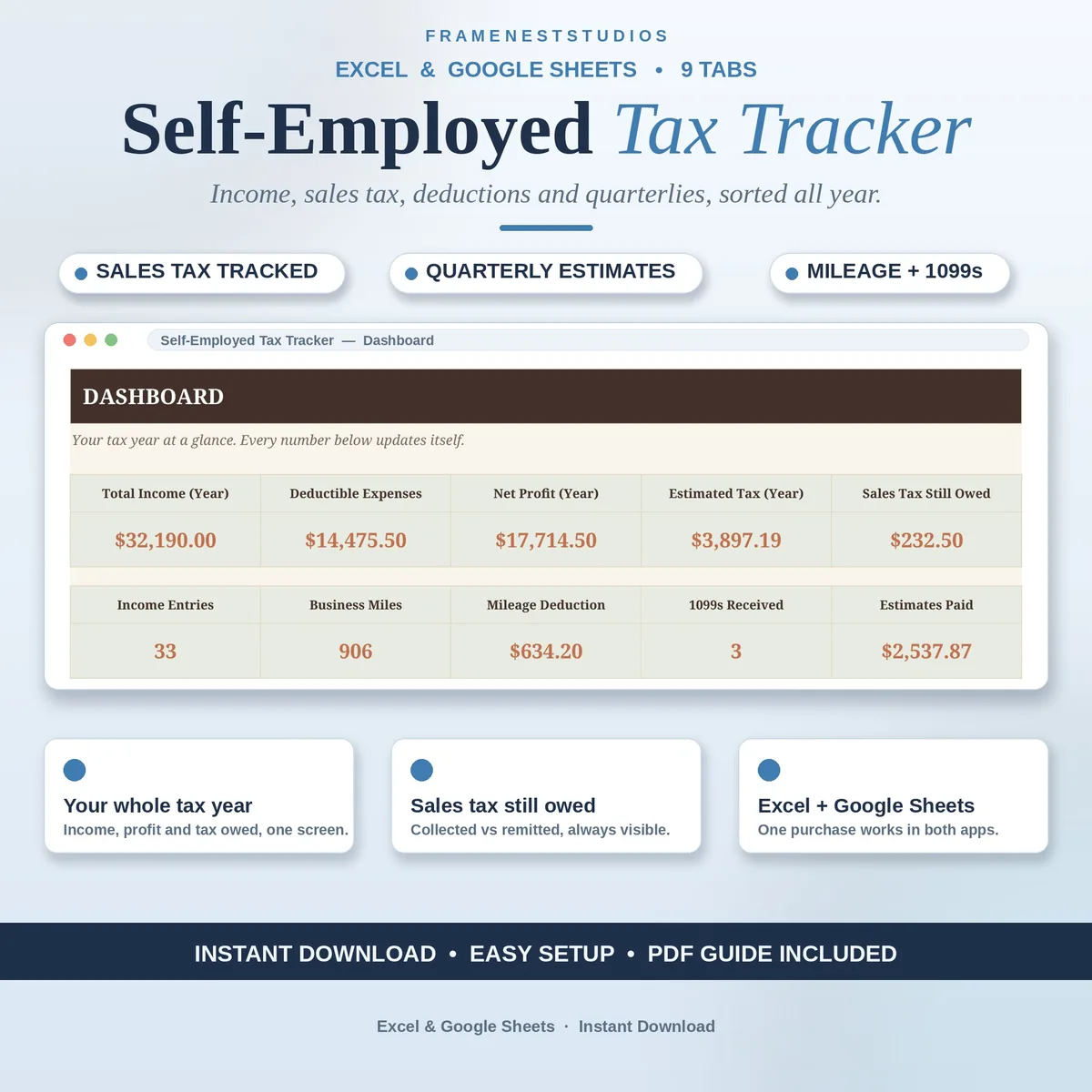
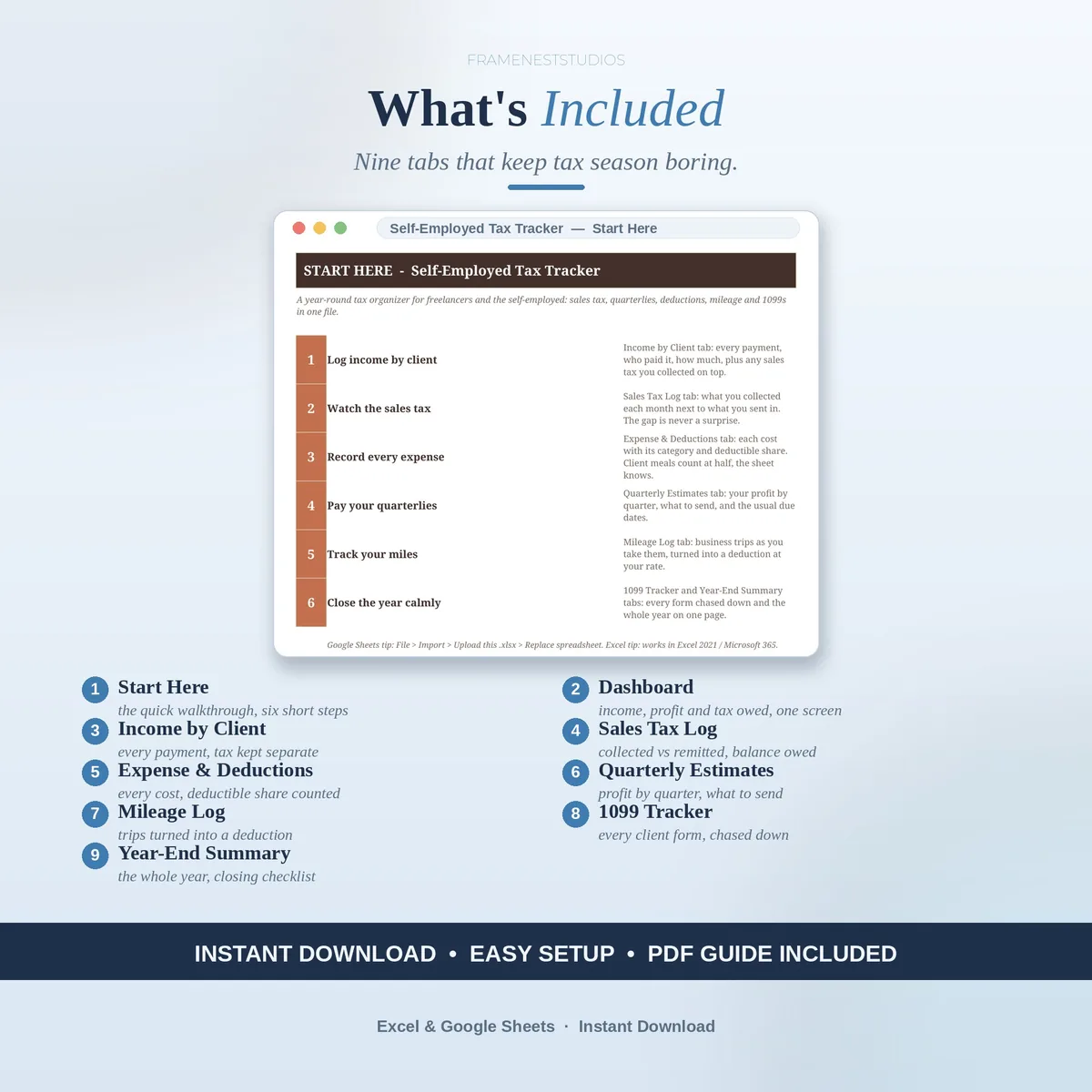
If you want that view without building your own system from scratch, our tax and VAT tracker spreadsheets lay it out for you: monthly income and expense tracking, a running tax set-aside total, and space to record each estimated payment you make. They work in Excel and Google Sheets, and they are an instant download on Etsy, so you can set yours up today and stop thinking about April.
Short on time? The Self Employed Tax Tracker does this for you in Excel and Google Sheets.
Set up the tracker, move your tax percentage into a separate account each time you get paid, and those four due dates become just another line in your calendar.
Income, sales tax, deductions and quarterly estimates in one calm year-round file. See every screen, the full tab list and buyer questions on the product page.
See the Self Employed Tax Tracker
Or browse more Taxes & VAT templates.