
Personal Loan Payoff Tracker
One loan, in depth: your payoff date, extra payment savings and a refinance check.
View on Etsy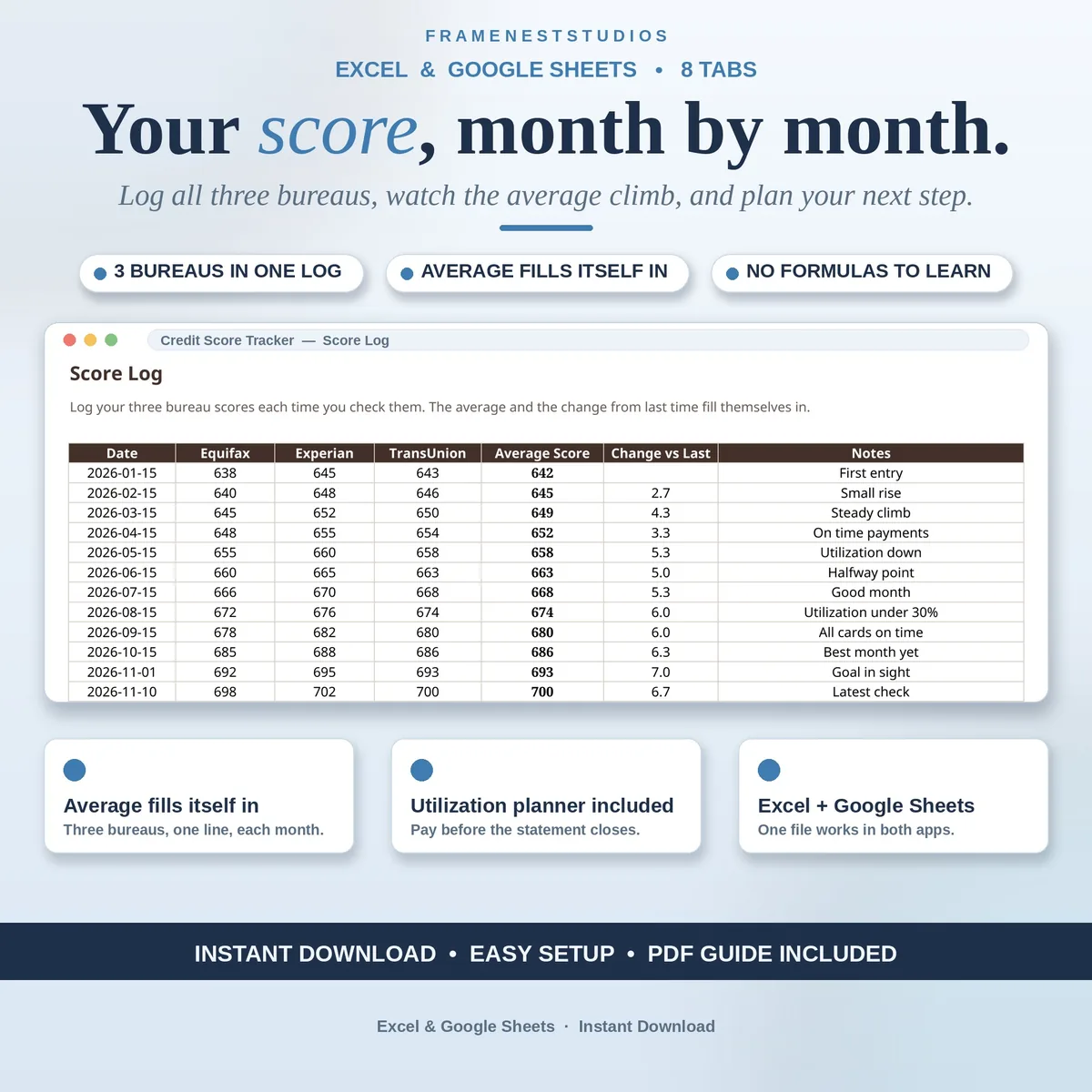
Your score moves a little every month, but most people only notice it when they need it. This credit score tracker keeps your Equifax, Experian and TransUnion numbers in one place, so you can watch the line climb, spot what is holding it back, and plan your next step with numbers in front of you.
Sale price in our Etsy shop right now. Checkout, payment and instant delivery are handled by Etsy.
It starts with the log. Each time you check your scores you add one row to the Score Log with the date and your three bureau numbers, and the average and the change since last time fill themselves in. One row a month is enough to turn a vague feeling about your credit into a visible line. The example file shows an average climbing across 12 entries, and your own line, whatever it does, will finally be something you can see.
Knowing the number is only half the job, so the Factor Breakdown explains what sits behind it. The five factors that shape a score are listed with their usual weights, payment history at 35 percent down to credit mix at 10 percent, and you rate yourself 1 to 5 on each. The sheet turns that into a weighted score and a plain status, strong, good, needs work or priority, with a note on what helps most for each factor.
The Utilization Planner is the practical heart of the workbook. Before each card statement closes, you enter the balance, the limit and the payment you plan to make, and it shows your utilization now, what it becomes after that payment, and a clear alert at the 30 percent and 10 percent lines. The Card Balances tab keeps every card's limit, balance and available credit together, while the Goal Score tab turns your target into points per month on a 12 month line.
The things buyers ask us most.
No. The tracker works with whatever you have, and plenty of people start with one or two scores. The average on the Score Log is most useful when all three are filled in, so log the ones you can access now and add the missing bureau later when you check it. The row still records the change from last time.
Once a month suits most people. Pick the same day each month so the change-from-last-time column compares like with like, and add a row whenever you check. The Score Log holds 24 rows, which is two full years of monthly checks, plenty of room to watch a goal line play out.
Not by itself. It shows you the utilization your card issuer is likely to report, based on the balance when the statement closes, and what your planned payment does to that figure before closing day. Paying early can lower the reported balance, and the planner simply makes the size of that effect visible before you decide.
Yes. You work in your own copy of the file, whether that is the Excel workbook on your computer or your own Google Sheets copy from the access link. Nothing you type is sent to us or shared with anyone else, and the tracker never connects to any bureau, bank or card account.
Three more workbooks from the same shelf.
One loan, in depth: your payoff date, extra payment savings and a refinance check.
View on EtsyUp to 4 car loans, a snowball or avalanche plan, and your debt-free date.
View on EtsyList every debt, pick snowball or avalanche, and watch your debt free date move closer.
View on Etsy