Your paycheck lands on Friday. By the middle of the month, the money is somehow gone. Rent went out, the card got used a few times, groceries happened, and now you are staring at your banking app wondering where it all leaked away.
You are not bad with money. You just never gave the money a plan before it arrived. That is exactly the problem the 50 30 20 budget was built to fix, and it does it with three numbers instead of a complicated spreadsheet full of rules you will quit by week two.
The 50/30/20 rule is a simple way to divide your after-tax income into three buckets. You spend 50% on needs, 30% on wants, and 20% on savings and extra debt payments.
That is the whole system. No envelope stuffing, no tracking every coffee in a notebook, no guilt spiral when you buy lunch out. The idea became popular through Elizabeth Warren's book "All Your Worth", and it stuck around for one reason. It is easy enough that normal people actually keep doing it.
Think of it as a rough map, not a strict law. Your percentages will wobble from month to month, and that is fine. The point is that every dollar gets pointed somewhere on purpose.
Here is where most people trip up on day one. The rule runs on your take-home pay, the amount that actually hits your bank account after tax. Not your salary. Not the number on your job offer letter.
If you earn $60,000 a year, you do not budget with $5,000 a month. You budget with whatever shows up in your account, which might be closer to $3,800 once tax, pension contributions and health insurance come out.
Freelancers and anyone with irregular income, listen up. Take your last three months of income, add them together and divide by three. Use that average as your base. In a good month, sweep the extra straight into savings before you can spend it. In a slow month, the average keeps your budget from falling apart.
Needs are the bills you must pay to keep your life running. Rent or mortgage, basic groceries, utilities, minimum loan payments, insurance, transport to work, your phone bill. If skipping it would cause real damage, it is probably a need.
Notice the word "basic" next to groceries. Groceries are a need. The fancy cheese and the third snack run of the week are wants wearing a disguise.
Wants are everything that makes life fun but not one bit more survivable. Eating out, streaming subscriptions, holidays, new trainers, concert tickets, the gym with the sauna you never use. This bucket is not the enemy. A budget with zero fun in it is a budget you will abandon by February.
The last 20% goes to savings and paying down debt faster than the minimum. Emergency fund first, then extra payments on the credit card or loan that charges you the most interest. If you have no emergency fund at all, even a small one, start there. Aim for one month of expenses, then build toward three.
Let us put real numbers on it. Say your take-home pay is $3,800 a month. Here is how the split looks:
| Bucket | Percentage | Amount on $3,800 | Covers |
|---|---|---|---|
| Needs | 50% | $1,900 | Rent, groceries, bills, minimum payments |
| Wants | 30% | $1,140 | Eating out, fun, subscriptions, treats |
| Savings | 20% | $760 | Emergency fund, extra debt payments |
Look at that savings number for a second. $760 a month is over $9,000 a year. Most people who say they "can't save" are not short of income. The money is just drifting out through the wants bucket without anyone noticing.
Now be honest about your own numbers. Add up your actual needs for last month. If they came to $2,300 on a $3,800 income, your needs are sitting at about 60%, which means something else has to give. That is not failure. That is information, and the next section is for exactly this situation.
Here is the part the glossy articles skip. If you live in an expensive city, rent alone can swallow 40% of your income before you have bought a single grocery. Add bills and transport, and your needs sail past 50% no matter how careful you are.
Do not throw the whole system away. Bend it.
Try a 70/20/10 split instead. Needs get 70%, wants get 20%, savings get 10%. On that same $3,800 paycheck, savings drop to $380 a month. Is that ideal? No. Is $380 a month saved automatically, every month, better than $0 saved while you wait for a cheaper apartment that may never come? Obviously yes.
Two rules for adjusting. First, protect some savings, even if it is only 5 or 10%. The habit matters more than the amount at the start. Second, squeeze wants before savings. Most people find $100 to $200 of wants they barely enjoy, like subscriptions they forgot existed. Cancel those before you touch the savings bucket.
And if your needs are over 70%? Then the honest answer is that this is an income and housing problem, not a budgeting problem. The budget still helps, because it shows you the exact size of the gap. But no spreadsheet can fix rent that costs more than half a paycheck on its own.
You do not need a free Saturday and a colour-coded binder. You need about an hour.
Then check in weekly, five minutes, coffee in hand. Compare what you planned with what actually happened, move on, no drama.
Counting gross pay. Already covered, but it is mistake number one for a reason. Budget with your salary instead of your take-home pay and every bucket is wrong from the start.
Forgetting irregular bills. Car insurance twice a year. The annual software renewal. Christmas. These are needs, they just do not show up monthly. Add up your yearly irregular bills, divide by twelve, and treat that amount as a monthly need. Future you says thanks.
Calling everything a need. The premium grocery store run, the daily takeaway coffee, the fastest internet package. Some of these are fine to keep, but file them under wants where they belong. When everything is a "need", the wants bucket looks empty and the savings never happen.
Setting it up once and never looking again. Your income changes, your rent changes, a kid arrives, a car dies. Recheck your percentages every few months. Ten minutes, twice a year, keeps the whole thing honest.
Yes, it is one of the best starting points there is. Most budgeting systems fail because they ask you to track forty categories. This one asks you to sort spending into three. Once you have run it for a few months, you can add detail if you want it. Most people find they do not need to.
Both, in the right order. Keep making every minimum payment first, because those sit in your needs bucket. Then build a small emergency fund, even $500 to $1,000, so one bad week does not go straight onto a credit card. After that, throw the rest of the 20% at your most expensive debt. Once the debt is gone, the full 20% becomes savings and investing.
Rent or mortgage, basic groceries, utilities, insurance, minimum debt payments, essential transport and your phone. The test is simple. If you stopped paying it, would your housing, health, job or credit score take a real hit within a month? If yes, it is a need. If you would just be annoyed, it is a want.
You can, but expect your percentages to look different. On a tight income, needs might take 70 or 80% no matter what you do. Use the rule as a direction to move in rather than a grade you pass or fail. Saving even 5% on purpose puts you ahead of where you were, and the split can grow as your income does.
Knowing the rule is the easy half. The hard half is checking your actual numbers against it every month, without spending your Sunday afternoons wrestling with formulas.
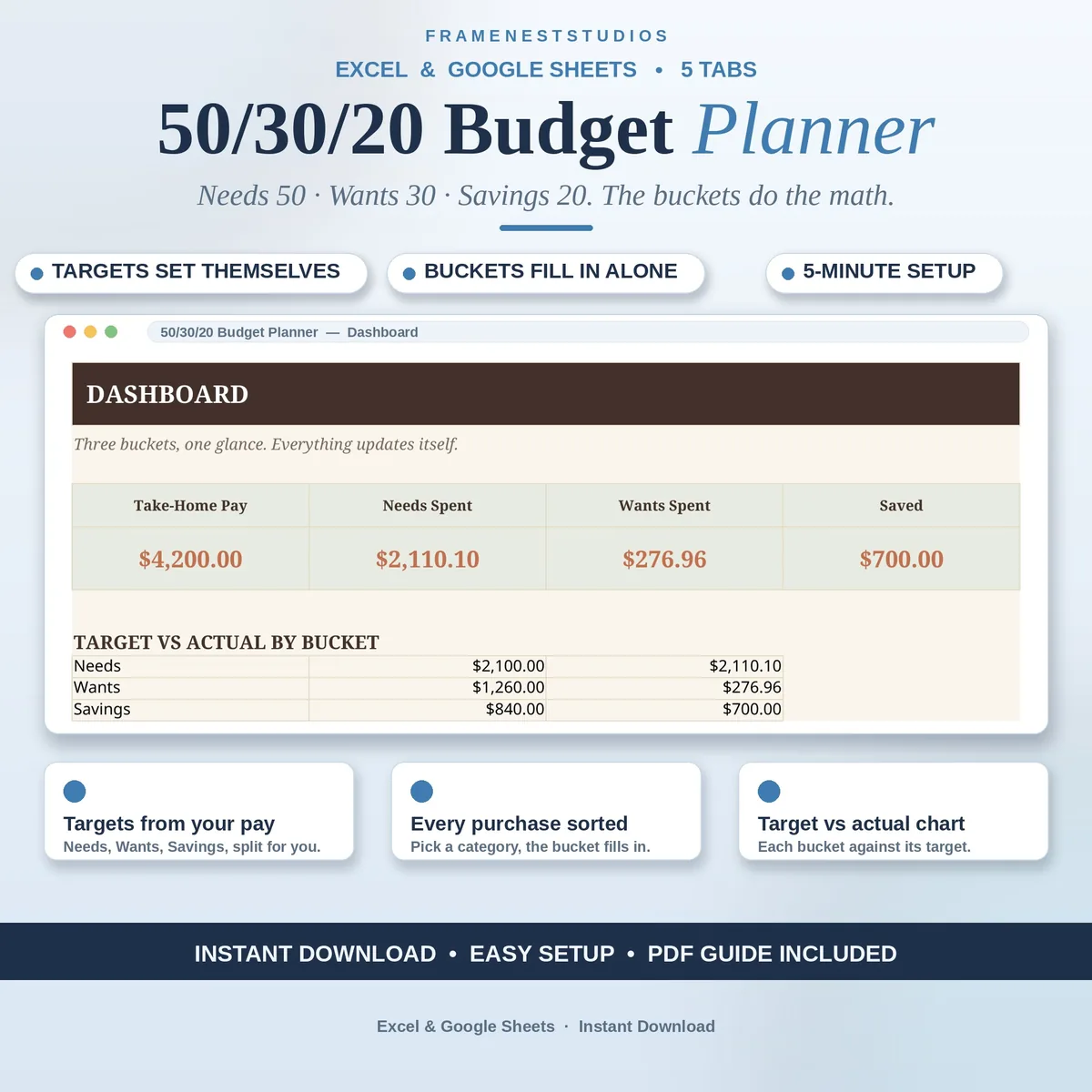
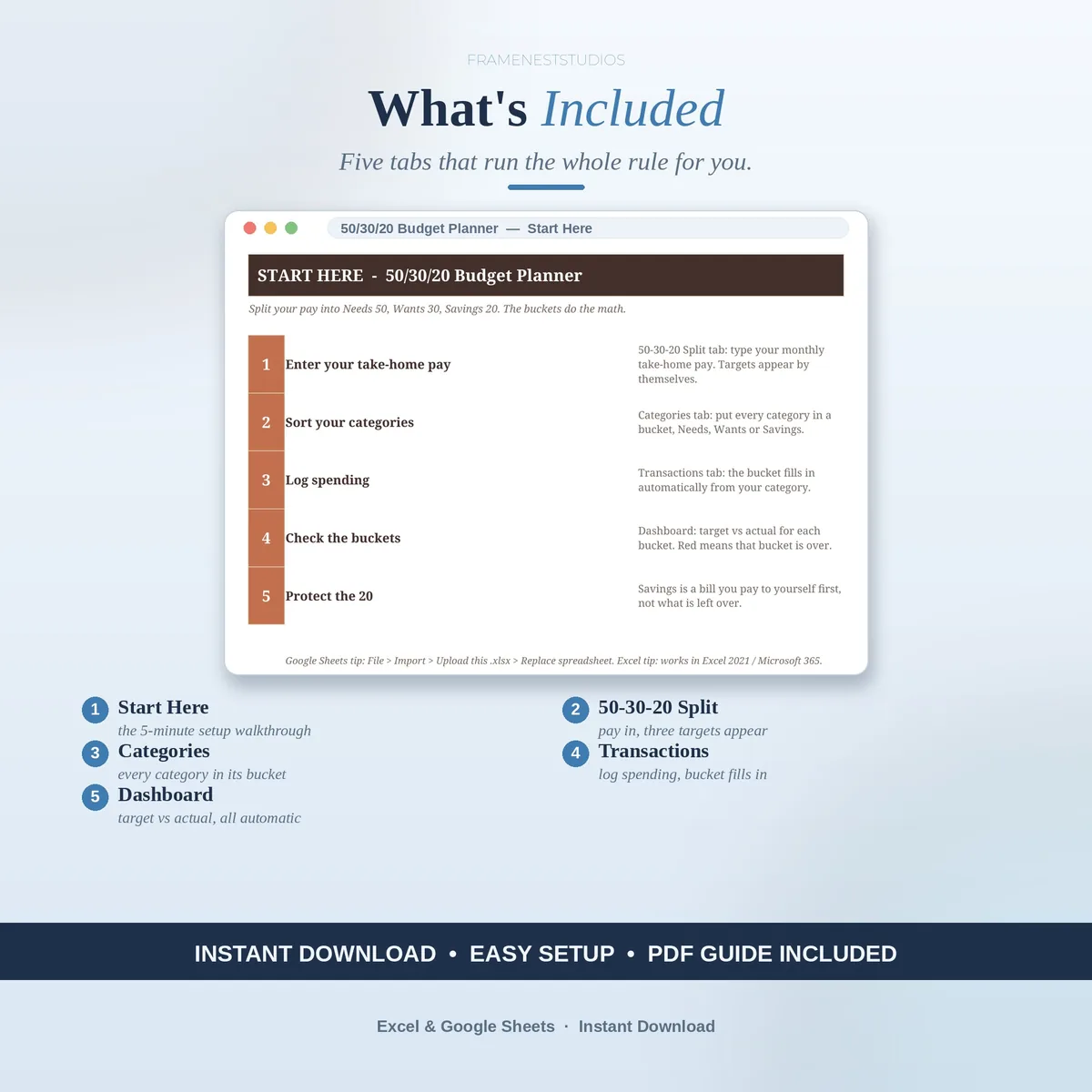
That is why we built our budget planner spreadsheet range at FrameNestStudios. Each monthly budget template comes with the needs, wants and savings buckets already laid out, the percentages worked out for you, and space to track what really happened next to what you planned. They run in Excel and Google Sheets, and they are instant downloads on Etsy, so you can set yours up tonight rather than next month.
Pick the planner that fits how you get paid, plug in your take-home number, and let the three buckets do the heavy lifting.
Short on time? The 50 30 20 Budget Planner does this for you in Excel and Google Sheets.
Set the budget up once. Check it weekly. Adjust it when life changes. That is the whole secret, and it fits on an index card.
Split pay into needs, wants and savings automatically, with targets set from your income. See every screen, the full tab list and buyer questions on the product page.
See the 50 30 20 Budget Planner
Or browse more Budgeting & Paycheck templates.