Five debts. Five due dates scattered across the month. You pay a bit on everything, the balances barely move, and by the 20th you are doing mental maths at the grocery store checkout.
Sound familiar? That scattered feeling is exactly what the debt snowball is built to fix. Not with a bigger income or a magic trick. With order. You line your debts up, knock out the smallest one first, and let each win push you into the next.
This guide walks through how the method works, shows a real example with real numbers, and gives you an honest look at where it beats the avalanche method and where it does not.
The debt snowball is a debt payoff plan where you pay your debts from the smallest balance to the largest, no matter what the interest rates are. You pay the minimum on everything, then put every spare dollar you can find onto the smallest debt until it is gone.
Once that one is cleared, you take the money you were paying on it and add it to the minimum payment of the next smallest debt. That combined payment is your snowball, and it grows with every debt you clear.
The idea is simple. Small debts are quick wins. Quick wins keep people going, and people who keep going are usually the ones who pay off debt faster in the end, simply because they do not quit.
You do not need an app or a finance degree for this. A notebook page works. Here is the whole method.
Write down every debt you owe, ordered by balance, smallest first. Ignore the interest rate completely at this stage. A $450 store card goes above a $9,600 car loan, even if the car loan has the lower rate. Credit cards, personal loans, medical bills, buy now pay later balances, all of it goes on the list.
Every debt gets its minimum payment, every month, on time. This part is not optional. Missed minimums mean late fees and a damaged credit score, and both of those make the hole deeper. The snowball only works if the rest of the list stays current while you attack the top line.
Now find your extra money. It does not have to be huge. Fifty dollars from cancelling two subscriptions. A hundred from a quieter grocery month. That money goes on top of the minimum payment for your smallest debt, and only that debt.
When the smallest debt hits zero, do not spend the money you were paying on it. Add it to the minimum payment of the next debt on your list. Your attack payment just got bigger without your budget changing at all. This is the moment the snowball earns its name.
Keep going down the list. Each cleared debt frees up a bigger payment for the next one, so the last, largest debts fall faster than you would expect. Most people are surprised how quickly the back half of the list moves.
Numbers make this easier to believe, so here is a realistic example. Say you have four debts and you can find an extra $150 a month on top of your minimums.
| Debt | Balance | Minimum payment | Payoff order |
|---|---|---|---|
| Store card | $450 | $25 | 1st |
| Credit card | $1,200 | $35 | 2nd |
| Personal loan | $3,800 | $95 | 3rd |
| Auto loan | $9,600 | $210 | 4th |
The store card gets its $25 minimum plus your $150 extra, so $175 a month. It is gone in about three months. That first zero balance feels better than you expect, honestly.
Now the roll starts. The $175 you were paying on the store card joins the credit card's $35 minimum, making a $210 monthly payment. The credit card clears in roughly six more months. Then $210 rolls into the personal loan's $95 minimum, and suddenly you are paying $305 a month on one debt. By the time you reach the auto loan, your payment has grown to $515 a month without you finding a single extra dollar beyond that first $150.
Compare that with spreading the same $150 thinly across all four debts. Nothing would be paid off for well over a year, and most people quit long before then. The snowball trades a bit of maths efficiency for momentum, and momentum is what finishes the job.
The avalanche method is the snowball's main rival. With avalanche, you order debts by interest rate, highest first, and attack the most expensive debt while paying minimums on the rest.
On paper, avalanche wins. Paying high interest debt first means you pay less interest overall, so it is the cheaper route if both plans are followed perfectly to the end. If your highest rate debt is also a small one, the two methods can even end up in the same order.
In real life, the picture changes. Personal finance research keeps finding the same thing: people who clear a small balance early are more likely to stick with their plan and clear their debt completely. A quick win in month three does something a spreadsheet cannot. It proves to you that this is working.
So who should pick which? If you are a numbers person who finds motivation in optimisation, and your biggest balance is not also your highest rate, avalanche will save you some interest. If you have tried paying off debt before and drifted away after a few months, the snowball method is probably the better fit. The best plan is the one still running in month nine, not the one that looked smartest in month one.
One honest warning. If one debt carries a much higher rate than the rest, something like a payday loan, the interest can grow faster than your snowball. In that case, clear that one first regardless of its size, then snowball the rest.
The method itself is forgiving, but a few habits can quietly undo it.
Stopping minimums on the big debts. It is tempting to pause the auto loan for a month and throw everything at the small card. Do not. One missed payment can cost more in fees and credit damage than a month of snowball progress is worth.
Adding new debt while you pay off the old. A snowball cannot outrun a credit card that keeps getting used. Many people cut up or freeze the cards for the payoff period. At the very least, take them out of your wallet and delete them from saved checkout details.
Skipping the emergency buffer. If you have zero savings, the first car repair or dentist bill goes straight back on a card, and the cycle restarts. Before you snowball hard, park a small starter buffer aside, even $500 to $1,000. It feels slow. It saves the whole plan later.
Quitting after the first debt. The early months feel underwhelming because the payment is still small. The method is backloaded by design. Judge it after the second or third debt clears, not the first.
Not by itself. Paying minimums on time and clearing balances usually helps your score over time, because your payment history stays clean and your card utilisation falls. Closing old cards right after payoff can nudge a score down slightly, so many people leave the oldest card open and unused.
It depends on your balances and how much extra you can pay. In the example above, the first debt cleared in about three months and the whole list in a few years. Your timeline will differ, but the first win should come fast, because the smallest debt is deliberately the easiest target.
Most people do not. A mortgage is large, long term and usually at a much lower rate, and the snowball is designed for consumer debts like cards and loans. Many households finish the consumer list first, build proper savings, and only then think about extra mortgage payments.
Avalanche costs less in interest on paper. Snowball keeps more people going, because the early wins are motivating. If motivation has been your problem in the past, snowball is likely the better choice for you. If you are disciplined and your rates vary a lot, avalanche may save you money.
You can run this method on paper, plenty of people do. But the rolling payment is easy to lose track of on paper, and watching the balances drop in one place is half the motivation.
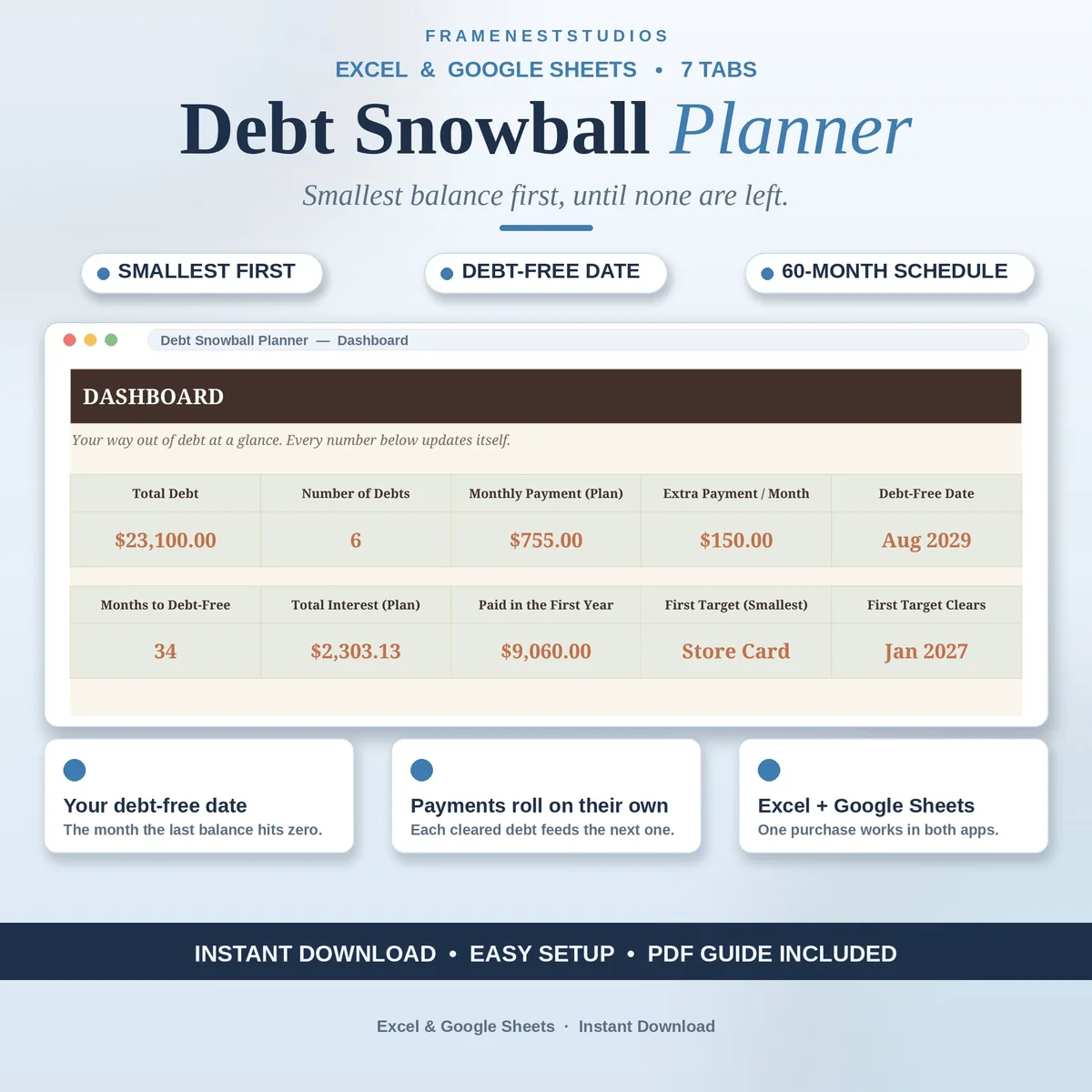
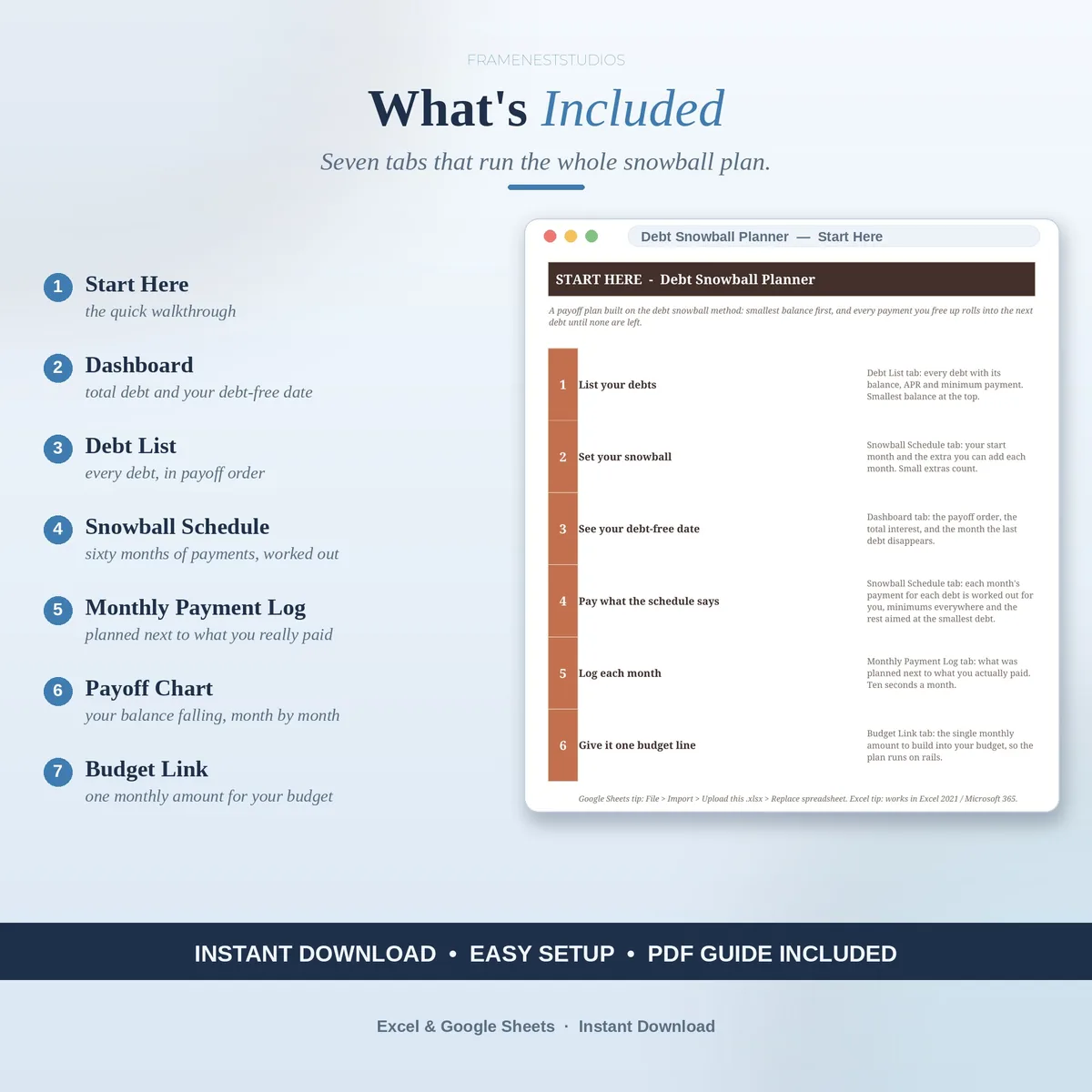
That is why we built our debt payoff and loan payoff tracker spreadsheets at FrameNestStudios. You list your debts once, smallest to largest, and the tracker shows your payoff order, tracks every payment, and shows your debt free date moving closer as the snowball grows. They work in both Excel and Google Sheets, and they are an instant download on Etsy, so you can set yours up tonight.
Short on time? The Debt Snowball Planner does this for you in Excel and Google Sheets.
Pick your smallest debt. Write it at the top of the page. That is your whole job this week, and it is enough to start.
Smallest balance first, freed payments rolled on, debt-free date included. See every screen, the full tab list and buyer questions on the product page.
Or browse more Debt & Loans templates.