Last month was your busiest yet. Orders came in every day, the stall sold out twice, and your sales total looked genuinely exciting. Then you checked the bank account and just stared at it. Where did it all go?
If that sounds familiar, you are not bad at business. You have probably just never sat down and worked out your profit properly. Most owners track sales because sales are easy to see. Profit hides. You do not need accounting software or a fancy profit calculator to find it. You need two formulas, your real costs, and about fifteen quiet minutes.
People say "profit" like it is one thing. It is two, and mixing them up causes most of the confusion.
Gross profit is what is left from your sales after you subtract the direct cost of what you sold. If you make a product, that means materials and packaging that goes out with each item. If you sell a service, it means the direct cost of delivering it.
Gross profit = Revenue − Cost of goods sold
Net profit is what is left after everything else comes out too. Fees, rent, ads, software, insurance, all of it. Net profit is the number that actually decides whether your business is working.
Net profit = Gross profit − Operating expenses
Gross profit tells you if your pricing makes sense. Net profit tells you if your business makes sense. You need both.
Let us use a small candle business, because the numbers are easy to follow and the mistakes are the same ones every product seller makes.
She sells handmade candles at $24 each. In March she sold 200 of them, so revenue was 200 × $24 = $4,800. A good month, on paper.
Each candle costs her $10 to make: $4.20 of wax, $1.90 of fragrance oil, $3.10 for the jar and lid, $0.35 for the wick, and $0.45 for the label. So her cost of goods sold is 200 × $10 = $2,000, and her gross profit is $4,800 − $2,000 = $2,800.
Then come the monthly costs that are not tied to one candle. Selling and payment fees took $385. Postage top-ups and shipping supplies came to $290. She spent $175 on ads, $200 on her market stall fee, and $40 on software. That is $1,090 in operating expenses.
Here is the whole month in one place:
| Line | Amount |
|---|---|
| Revenue (200 candles at $24) | $4,800 |
| Cost of goods sold (200 × $10) | −$2,000 |
| Gross profit | $2,800 |
| Operating expenses (fees, shipping, ads, stall, software) | −$1,090 |
| Net profit | $1,710 |
So the "great" $4,800 month was really a $1,710 month. That is still a decent result, by the way. But it is a very different number from the one she was celebrating, and it is the only one she can plan with.
A dollar figure tells you how much you made. A percentage tells you how well you made it, and percentages are what let you compare one month, one product, or one business with another. Doing this by hand is basically using yourself as a profit margin calculator, and the formula is short:
Profit margin = (Profit ÷ Revenue) × 100
Using the candle numbers: gross margin is $2,800 ÷ $4,800 = 58.3%. Net margin is $1,710 ÷ $4,800 = 35.6%.
That net margin is the number to watch. If next month she sells more candles but the margin drops to 22%, something quietly got more expensive, and the percentage spots it long before the bank balance does.
Owners always ask this, and the honest answer is that it depends heavily on what you sell. Treat these as rough guides from what accountants and lenders commonly quote, not as promises or targets you must hit:
If your number sits below the rough range for your type, do not panic. It usually points to one fixable thing: prices a touch low, one cost that crept up, or too much spent chasing sales.
If the candle maker spent 60 hours in March and paid herself nothing, part of that $1,710 is really wages she owes herself. You do not have to book a formal salary, but at least know the number. Profit that only exists because you worked free is not profit yet.
One account for everything feels easier. It is not. The moment a personal grocery run and a supplier payment sit in the same list, your profit figure is a guess. A separate account, even a free one, fixes most of this overnight.
Marketplace fees, payment processing, refunds, the parcel that came back damaged. Each one is small. Together, in the example above, fees alone were $385, which is more than a fifth of the net profit. If you skip them, you are grading your own homework kindly.
Revenue is the vanity number. It feels great and means very little on its own. A $10,000 month can lose money and a $3,000 month can be nicely profitable. Always ask what is left, not what came in.
You do not need a year-end marathon. A short monthly routine beats it, because you catch problems while they are still small. Any basic profit calculator can crunch these numbers for you, but the routine matters more than the tool.
Do this twelve times and you will know your business better than most owners ever do. You will also walk into tax season holding answers instead of a shoebox.
Add up all your sales for the period to get revenue. Subtract the direct cost of what you sold to get gross profit. Then subtract every other business cost (fees, rent, ads, software) to get net profit. That final number is your profit.
Net profit = Revenue − Cost of goods sold − Operating expenses. Some people write it as gross profit minus operating expenses, which is the same thing in two steps. Tax is usually worked out after this, based on the net figure.
It depends on the type of business. Many healthy small businesses run a net margin somewhere between 10% and 30%, with restaurants often lower and service businesses often higher. Your own trend matters more than any benchmark: a margin that rises slowly beats a "perfect" number that keeps falling.
No, and this trips up almost everyone. Your bank balance includes money that is already spoken for (tax, supplier bills, next month's rent) and misses money you are owed but have not received. Profit is worked out from sales and costs for a period. Cash is what is physically there today. Both matter, and they are rarely equal.
You can absolutely run the fifteen minute check above on paper or in a blank spreadsheet. Most owners start there, and plenty give up by month three, because rebuilding the same layout from scratch every time is nobody's favourite job.
That is exactly why we built the bookkeeping and profit tracking spreadsheets in our Etsy shop. They lay out revenue, costs and profit the way this article walks through it, with the formulas already in place, so your monthly check becomes filling in numbers instead of building a system. Think of it as a profit calculator that remembers last month too, so you can see the trend instead of a single lonely figure. They work in both Excel and Google Sheets, and they are instant downloads, so you can run your first proper profit check today.
Take a look here:
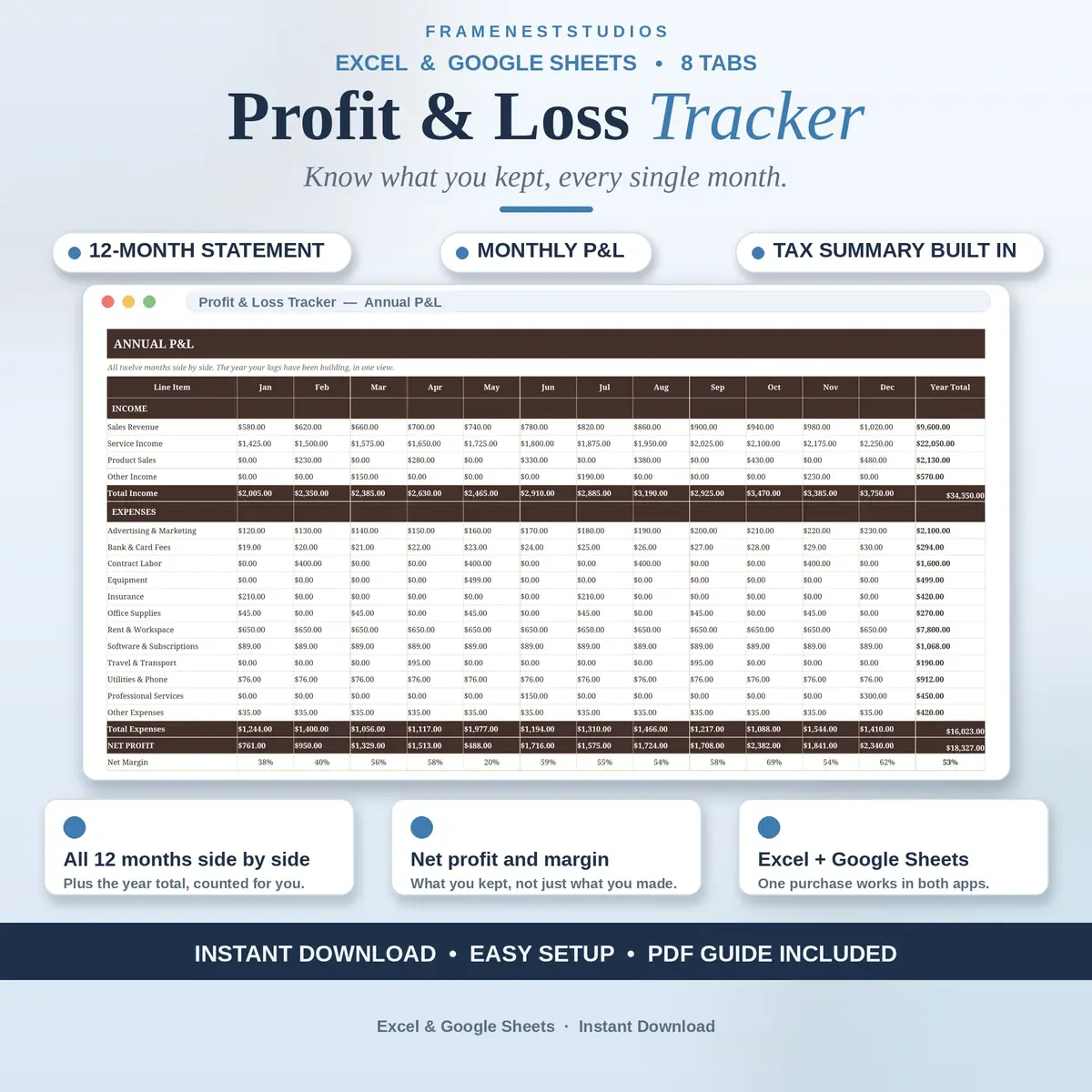
Short on time? The Profit and Loss Tracker does this for you in Excel and Google Sheets.
Run the numbers once, honestly, fees and all. Whatever the figure turns out to be, knowing it is the point where the business starts getting easier to run.
Turn income and expense logs into a clean profit and loss statement every month. See every screen, the full tab list and buyer questions on the product page.
See the Profit and Loss Tracker
Or browse more Bookkeeping & Business Finance templates.